



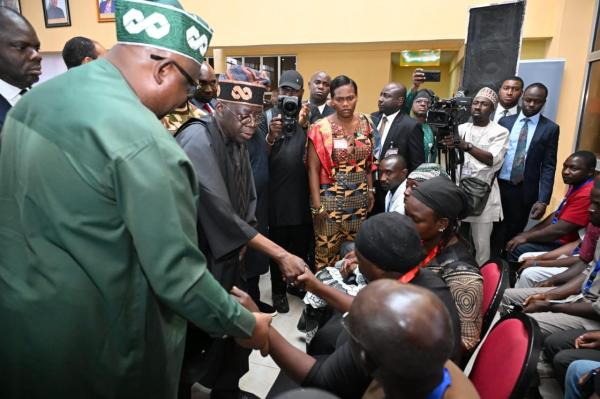
The Presidency has defended President Bola Tinubu’s decision to meet victims of the Plateau State killings at a facility near the Yakubu Gowon Airport in Jos, rather than visiting affected communities within the city, citing logistical and aviation constraints.
In a statement issued on Friday, the President’s Special Adviser on Information and Strategy, Bayo Onanuga, explained that the airport’s runway lacks the navigational aids required for night operations. As a result, the President could not travel into Jos township and return in time for departure before dusk.
According to the statement, the approximately 40-minute road journey between the airport and the city centre, combined with the flight limitations, made it impractical to conduct an on-site visit. Authorities therefore arranged for representatives of the affected communities to meet the President at a hall adjoining the airport.
The visit followed a deadly attack on the Angwan Rukuba area of Jos North Local Government Area on Palm Sunday, where at least 28 people were killed in one of the state’s most severe outbreaks of violence in recent years.
The Presidency also attributed delays in the President’s departure to a prior engagement in Abuja, where Tinubu hosted Chadian President Mahamat Idriss Déby Itno for bilateral talks focused on regional security cooperation. The meeting reportedly exceeded its scheduled duration.
Officials noted that Tinubu had initially planned to travel to Iperu in Ogun State but suspended the trip after receiving a security briefing from Plateau State Governor Caleb Mutfwang. Preparations for the Jos visit were subsequently made overnight.
Despite the airport-based meeting, the Presidency maintained that the visit achieved its purpose. The President met with victims, engaged community leaders, and consulted with security chiefs on measures to address the crisis.
During the visit, Tinubu expressed sympathy to victims, including a grieving mother whose loss had drawn widespread attention. He also announced plans to deploy over 5,000 AI-enabled surveillance cameras across Plateau State, directed security agencies to apprehend those responsible, and approved the establishment of a committee to assess damages and recommend compensation.
Additionally, the Nigerian Army confirmed the deployment of more than 850 troops to strengthen ongoing security operations in the state.
The Presidency described the visit as a strategic engagement aimed at fostering dialogue and addressing the root causes of violence in Plateau.
However, the visit has attracted criticism from opposition figures. Former Vice President Atiku Abubakar described the approach as insensitive, arguing that the President failed to visit the affected communities directly. He also questioned the prioritisation of engagements, suggesting the trip was prematurely concluded.
The Presidency, however, insisted that the constraints were unavoidable and that the President’s intervention underscored his commitment to restoring peace and stability in the state.