



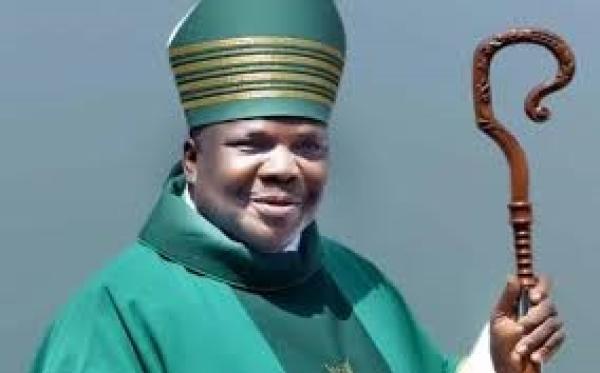
The Bishop of the Catholic Diocese of Oyo, Most Rev. Emmanuel Badejo, has issued a stirring call for National Renewal, urging governments at all levels to return to the core purpose of governance: serving the genuine interest of the people rather than the whims of political survival. In a sweeping reflection on the state of the nation, the Bishop asserted that the true efficacy of a democratic system lies in the hands of an informed and active citizenry, famously stating that “democracy works when the people know the power they have.”
Bishop Badejo reminded leaders that the democratic ideal was never meant to be a tool for personal aggrandizement but was designed as a protective barrier for the common man. He noted that democracy was born specifically to reduce the abuse of power by men who find themselves in positions of authority. To this end, he challenged leaders to adopt a “servant-leadership” model, warning that any leadership that divides rather than reconciles the people “has no legitimacy and should be rejected.” He further cautioned that power is temporary, and that all leaders will be judged by history and eternity based on their commitment to the common good, asking the poignant question: “What will I be remembered for?”
Drawing on the need for a solid moral foundation to strengthen democratic principles, the Bishop lamented that despite significant strides since the return to civilian rule, the country remains dangerously polarized along religious lines. He warned that it is a tragedy when citizens continue to die daily in the name of both democracy and religion. Consequently, the Bishop called for collective action from government officials, religious leaders, and civil society to promote peaceful coexistence. He highlighted honesty as vitally important in the practice of democracy and emphasized, “The essence of democracy is the defence of human rights anchored on the principles of equity and fairness.”
The Nigerian Catholic Bishop also linked democracy and freedoms, saying that a country’s democratization can be measured by how well it upholds the principles of democracy such as freedom of religion, freedom of speech, and freedom of the press. He insisted that authentic religion must serve as a building block for democratic growth rather than a catalyst for conflict, urging leaders to stop exploiting religious sentiments for selfish political gains.
Looking at the evolution of modern governance, the Bishop, who is also a member of the Vatican Dicastery for Communication, offered a sharp critique of how contemporary politicians have become enslaved to public optics. He warned that a distorted need to be seen as responsive to the "will of the people" has resulted in leaders who “almost have to look at the opinion polls to act,” rather than leading with conviction or moral clarity. He said that visionary leadership with short-term popularity contests can lead to the erosion of truth and the abandonment of principled governance in favor of media hype and propaganda.
In his most urgent appeal, Bishop Badejo warned that the erosion of public trust has created a “dangerous situation” for the country. He noted that when corruption and lack of transparency become the norm, it fuels social breakdown and becomes an incubator for banditry and crime. He pointed out that systemic failure is often a human failure, stating, “The inability of a system to deliver on the principles of democracy is not out of bad will; it is largely because we have not dealt with the question of who and who are delivering on the services.” He insisted that governance must not be suspended for election campaigns, urging the executive, legislature, and INEC to remain on the side of equity and justice to rehabilitate the nation.
Beyond the halls of power, His Lordship exhorted the electorate, particularly the youth and civil society, to seize the moment and demand a “new dawn.” He challenged Nigerians to reclaim the country by turning “perpetual potentialities into huge actualities” through honest work and accountability. Highlighting the role of civic education, he noted that “an uninformed and ignorant populace will always be extremely difficult to serve or lead.” By reclaiming their voice and holding elected leaders accountable both during and after elections, Bishop Badejo believes the people can ensure that power remains a service to the many. “The country is not beyond repair,” he stressed, urging all citizens to channel their common energy toward “rescuing Nigeria to be great again.