


The University of Ibadan (UI), in strategic partnership with global educational technology firm Astria Learning, has intensified calls for stronger collaboration between universities and the corporate sector, urging Nigerian graduates to look beyond academic certificates and acquire the practical skills required to thrive in an increasingly competitive global job market.
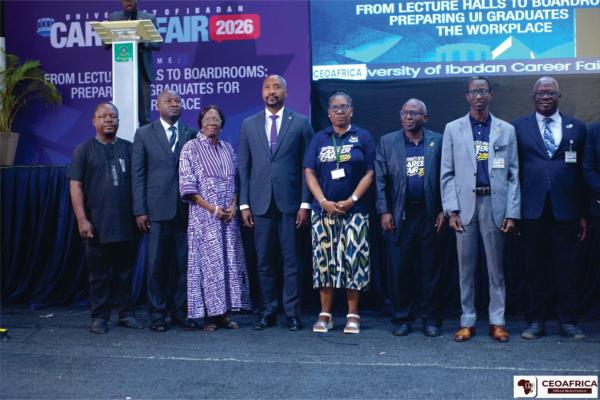
The call was made at the UI Career Fair 2026, held on Thursday, November 5, at the International Conference Centre, University of Ibadan, under the theme, “From Lecture Halls to Boardrooms: Preparing UI Graduates for the Workplace.”
The landmark gathering brought together university administrators, corporate executives, human resource professionals, technology experts, financial institutions, recruiters and students from various faculties to address youth unemployment, bridge digital skills gaps and create stronger pathways between academic learning and employment opportunities.
Declaring the event open, the 14th Vice-Chancellor of the University of Ibadan, Professor P. O. Olapegba, described the career fair as an important institutional platform for preparing students for the realities of the modern workplace, stressing that obtaining a university degree must be accompanied by the ability to translate knowledge into measurable results.
In his first career fair under his administration, Professor Olapegba challenged students to embrace professional development early, build confidence and acquire the competencies necessary to compete successfully in the corporate world.
He noted that the transition from university to the workplace requires a fundamental change in mindset, explaining that graduates must move beyond theoretical knowledge to practical problem-solving, independent decision-making and effective collaboration.
“The transition from the lecture hall to the workplace is more than the completion of a degree programme. It is rather a transition from acquiring knowledge to applying it; from learning theory to solving practical problems; from being guided by lecturers to taking responsibility for decisions; and from preparing for the future to actively shaping it,” he said.
Addressing the growing influence of artificial intelligence, automation and digital technologies on employment, the Vice-Chancellor maintained that Nigerian graduates must demonstrate practical competence, creativity, emotional intelligence, resilience and the ability to adapt to changing workplace demands.
He declared that Nigeria's youthful population could become a major driver of national development if young people were equipped with relevant skills and provided access to meaningful economic opportunities.
“Our graduates must therefore be prepared to demonstrate more than what they know. They must show what they can do with what they know,” Professor Olapegba emphasised.
He further urged students from the university's main campus, the College of Medicine at the University College Hospital (UCH) and affiliated institutions to develop strong work ethics, communication skills and problem-solving abilities before graduation.
Reinforcing the Vice-Chancellor's position, Professor K. O. Adebowale urged undergraduates to maximise the opportunities presented by the career fair, noting that academic qualifications alone were no longer sufficient to guarantee professional success.
He stressed the importance of strategic networking, foresight and early career positioning in preparing students for leadership responsibilities in the corporate sector.
Also speaking, the Deputy Vice-Chancellor for Research, Innovation and Strategic Partnerships, Professor Simisola Oluwatoyin Akintola, highlighted the university's commitment to connecting academic research, innovation and human capital development with the practical needs of industry.
She identified critical thinking, adaptability, cybersecurity awareness, financial literacy, emotional intelligence and digital proficiency as essential competencies for graduates seeking to succeed in contemporary workplaces.
Professor Akintola, however, drew attention to the digital divide confronting many undergraduates, particularly final-year students who lack personal laptops and other essential digital tools needed to access virtual training, professional certifications and corporate internship opportunities.
She maintained that access to technology had become a necessity rather than a luxury in modern education and professional development, calling for stronger partnerships with stakeholders to ensure that financial limitations did not prevent talented students from accessing available opportunities.
She also stressed that technical competence must be matched with sound character, ethical conduct and professionalism for graduates to sustain long-term career success.
Providing details of the programme's implementation, the Convener of the UI Career Fair 2026, Dr. Oluchi C. Maduka, disclosed that the event was designed around extensive consultations with students to identify their career development needs and the challenges confronting their transition into employment.
According to her, the fair featured recruitment opportunities, career counselling, professional networking and skills development sessions covering workplace readiness, entrepreneurship, digitalisation and international scholarship opportunities.
She revealed that the Career Fair Committee had gone beyond organising a one-day event by establishing continuous masterclasses and skills workshops scheduled to run into early 2027.
As part of efforts to address the digital access gap, Dr. Maduka disclosed that the committee was working towards securing laptops for committed final-year students through partnerships with university donors, alumni and corporate sponsors.
She also announced plans to establish a data-driven tracking system for monitoring student internship placements, evaluating workplace experiences and obtaining performance feedback from organisations hosting the students.
Highlighting existing institutional achievements, she referenced the International Institute of Tropical Agriculture's (IITA) engagement of 544 students and graduates over the past two years, as well as the DAAD partnership through which nine University of Ibadan European Studies students received German summer course scholarships this year.
A major highlight of the career fair was the participation of Astria Learning, the event's major co-organiser and primary educational technology sponsor, led by its Founder and Chief Executive Officer, Dr. Jeff Bordes.
Dr. Bordes, whose organisation has established a presence across Nigeria, Ghana, Uganda, Malawi, Zambia and Tanzania, emphasised the urgency of preparing Nigerian graduates for a global economy increasingly shaped by artificial intelligence and automation.
Founded in 2012, Astria Learning develops and manages digital learning infrastructure for higher institutions, providing technology, admissions support, student services and academic operations that enable universities to deliver online degree programmes.
With more than 250 employees and over 1.2 million working professionals empowered globally to earn degrees without leaving their jobs, the organisation deploys Learning Management Systems, Student Management Systems and AI-assisted digital libraries to expand access to education.
Drawing attention to the changing realities of employment, Dr. Bordes warned that graduates were no longer competing exclusively within their local economies but were increasingly exposed to a borderless international labour market.
“The global job market is not waiting for anyone. With Artificial Intelligence and automation reshaping industries overnight, Nigerian graduates are no longer competing locally, they are competing on a borderless global stage. If you wait until graduation day to master digital tools and future-ready skills, you are already behind. The transition to boardroom readiness must begin today,” he stated.
He explained that Astria Learning's partnership with the University of Ibadan was aimed at accelerating graduate preparedness through access to digital learning resources, personalised skills development pathways and scalable career readiness programmes suited to the demands of an AI-driven global workforce.
The collaboration also received support from major corporate and financial institutions, including First Bank Plc, Aradel Holdings, Optimus Bank, Afe Babalola & Co., Stanbic IBTC Pension Managers, Sumal Group of Companies, Beta Glass Plc, Deloitte Nigeria and the DAAD Regional Office in Accra.
Dr. Maduka expressed appreciation to the sponsors and institutional partners for their contributions towards making the initiative a platform for meaningful student development and industry engagement.
The President of the UI Students' Union Government, Comrade Adeboye Temidayo, also mobilised students to take advantage of the opportunity, urging them not to allow their university experience to revolve exclusively around academic grades.
He described the fair as an important opportunity for students to interact directly with chief executives, human resource directors and industry leaders capable of opening doors to internships, employment and international scholarship opportunities.
Speaking during an exclusive interaction with CEOAFRICA, students who participated in the programme expressed appreciation for the initiative, describing the exposure as a valuable opportunity to understand the expectations of employers and the practical demands of professional life.
One of the participants, Blessing Adeleke, a final-year student, said her interaction with corporate leaders and human resource experts had significantly reshaped her understanding of career preparation.
She explained that beyond academic excellence, graduates must learn to communicate their value, demonstrate emotional intelligence, adapt to digital technologies and build meaningful professional relationships.
The career fair concluded with employer engagement sessions, personal branding masterclasses, CV review clinics and direct networking opportunities, bringing students and recent graduates into contact with decision-makers from multinational companies, technology organisations and leading financial institutions.
Beyond the networking opportunities and corporate presentations, the 2026 edition signalled a renewed commitment by the University of Ibadan and its partners to making employability, practical skills acquisition and industry engagement an integral part of university education.
With continuous training programmes extending into 2027 and plans to address students' access to digital tools, the initiative seeks to ensure that graduates are not merely equipped with certificates but are prepared to deliver value in an evolving global economy.
As the message from the fair made clear, the future belongs not simply to graduates who know, but to those who can demonstrate what they know, turn ideas into solutions and transform their knowledge into results.