


Chinedum Peace Babalola, a Professor of Pharmaceutical Chemistry and former Vice-Chancellor, has called on Nigerian universities to move beyond theoretical research and focus on practical interventions capable of addressing the pressing challenges facing their host communities.
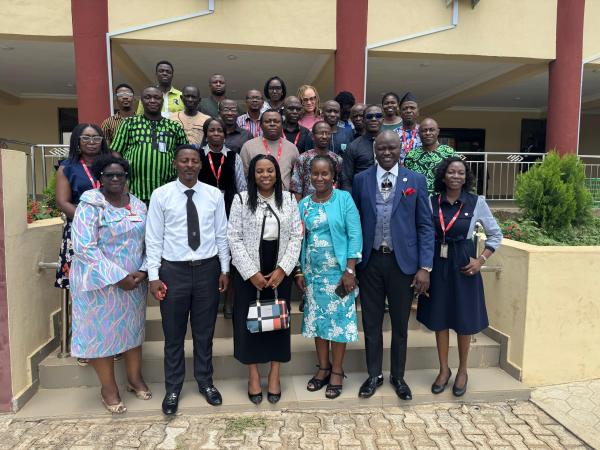
She made the call while delivering the keynote lecture at Bowen University on May 11, 2026. The lecture, titled “From Ideas to Impact: Showcasing and Strengthening Research Excellence in Bowen,” emphasized the need for universities to become active drivers of national development through impactful research and innovation.
According to Prof. Babalola, universities can no longer limit themselves to their traditional responsibilities of teaching and research, especially at a time when societies are confronted with growing economic, social, environmental, and technological challenges facing the nation.

She stressed that institutions of higher learning must produce research outcomes that directly improve lives and contribute meaningfully to community development.“A university has not fulfilled its mandate if it exists in a community and that community remains unchanged,” she stated.

The Vice-Chancellor of Bowen University, Jonathan O. Babalola, who was ably represented by the Deputy Vice-Chancellor, Prof. Tunde Lawal, described the lecture as timely and significant. He noted that universities must evolve from being mere degree-awarding institutions into centres of innovation, creativity, and knowledge production capable of driving sustainable national development.Prof.
Babalola reiterated that the traditional tripartite mandate of universities worldwide, teaching, research, and community service, must now be strengthened with deliberate efforts to translate academic discoveries into tangible societal benefits.

She explained that modern universities are increasingly expected to contribute directly to economic growth by ensuring that innovations developed within academic environments are transformed into products, policies, and solutions that benefit the wider public.

Highlighting the importance of purposeful research, she warned that Nigeria’s development is closely tied to the quality and relevance of its research output.
“If research is done right, our problems will be reduced and development accelerated; but if neglected, it will amount to motion without movement,” she said.
The scholar also called for comprehensive reforms within Nigeria’s university system, insisting that institutions must deliberately reposition themselves as centres for producing knowledge and highly skilled individuals capable of contributing to nation-building.
She advocated stronger collaboration between academia and industry to ensure that research findings are effectively commercialized and translated into practical applications.
Prof. Babalola expressed concern over Africa’s low contribution to global research output, noting that despite accounting for about 16 per cent of the world’s population, the continent contributes only about 2.5 per cent of global research production.

She further highlighted Nigeria’s dependence on imported pharmaceuticals, revealing that approximately 70 per cent of drugs used in the country are imported. According to her, the situation underscores the urgent need for local drug discovery, development, and manufacturing through research institutions and specialized centres. To combat this, she drew from her personal journey in establishing the Centre for Drug Discovery, Development and Production (CDDDP) at the University of Ibadan, citing it as a blueprint for how local drug discovery and specialized research centers can reduce foreign dependency and touch lives directly. To underscore the need for relevance in academic research, she challenged scholars to evaluate the societal value of their work by asking a simple question: “If my research disappeared today, who would miss it?”
She lamented that many research findings remain unused and inaccessible, ending up on shelves instead of solving real societal problems such as poverty, disease, and industrial inefficiency.
As part of her recommendations, Prof. Babalola unveiled a 10-step “Idea-to-Impact” framework designed to help institutions to investigate, validate, protect, develop, translate, and commercialize their intellectual property through multidisciplinary collaboration. She encouraged universities to promote multidisciplinary collaboration among scientists, technologists, and innovators in tackling complex national problems.
She also cited examples of young Nigerian innovators, including Eniola Shokunbi, who developed an air filtration solution for schools, and a group of girls from Onitsha who created an application for detecting counterfeit drugs. The presentation left a profound impression on the university leadership, with Prof. Tunde Lawal describing the engagement as deeply enriching and expressing a strong urge to bring Prof. Babalola back for future strategic mentoring. Prof. Babalola extended her sincere appreciation to Dr. Daniel Ogunlakin for his pivotal role in processing the invitation, as well as the Vice-Chancellor, Professor J. Babalola, the Deputy Vice-Chancellor, Prof. Tunde Lawal, and the Director of Research, Prof. Adeyemi, for their excellence in organization.The impact was equally felt by the students, one of whom shared a moving testimony on social media, describing Prof. Babalola as the woman in academia she aspires to be.
In her closing remarks, the professor urged academics to remain focused and intentional in their pursuit of excellence, while challenging Bowen University to set a five-year target of becoming one of Africa’s leading research institutions through the development of patents, innovative products, and spin-off companies.
Using an agricultural metaphor, she described ideas as seeds, research as cultivation, innovation as harvest, and societal impact as the fruit that ultimately benefits humanity.