



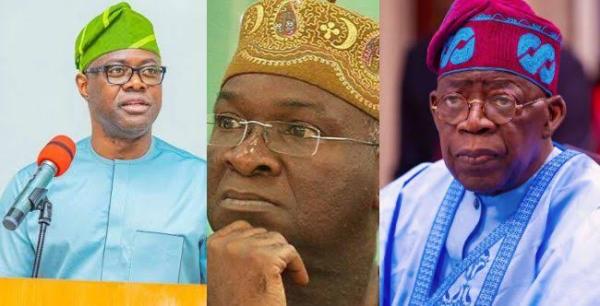
The Allied Peoples Movement (APM) has criticised former Minister of Power, Works and Housing, Babatunde Fashola, over his defence of President Bola Tinubu’s electricity reforms, accusing the administration of failing to fulfil its campaign promises on stable power supply and the elimination of estimated billing.
The criticism followed Fashola’s appearance on a national television programme, where he defended the President’s electricity policy, arguing that Tinubu never promised Nigerians 24-hour electricity.
Reacting in a statement on Friday, Director of Strategic Communications of the Makinde-Daura Presidential Campaign Organisation, Richard Ihediwa, described Fashola’s position as embarrassing, insisting that the President made clear commitments to Nigerians during the 2023 presidential campaign.
The campaign organisation recalled Tinubu’s campaign promise that Nigerians would have access to electricity and would no longer be subjected to estimated billing, quoting him as saying: “Whichever way, by all means necessary, you must have electricity. And you will not pay for estimated bill anymore. A promise made, will be a promise kept.
It also recalled Tinubu’s declaration that Nigerians should not re-elect him if he failed to fulfil the promise without providing adequate reasons.
Questioning the administration’s performance, the APM campaign organisation asked whether the President had delivered on those commitments since assuming office in 2023.
According to the group, despite several policy announcements, legislative reforms and interventions in the electricity sector, Nigerians continue to experience persistent power supply challenges.
It further cited an estimated 86.8 million Nigerians without access to public electricity connections, describing the country’s electricity access deficit as one of the largest globally.
The organisation also challenged Fashola’s claim that he did not have the figures on estimated billing, citing data from the Nigerian Electricity Regulatory Commission (NERC), which it said showed that approximately 4.70 million electricity customers remained without meters and were consequently exposed to estimated billing.
On electricity infrastructure, the campaign group referenced NERC’s May 2025 Performance Improvement Plan order for the Transmission Company of Nigeria and the Nigerian Independent System Operator, alleging that only ₦1.7 billion had been disbursed for eight projects between January 2024 and January 2025.
It further claimed that only 45 per cent of approved funding for 2024 had reached the designated account, while procurement delays and inadequate project prioritisation affected implementation.
The group also criticised the relocation of power supply arrangements at the Presidential Villa to solar energy, arguing that the development raised questions about the administration’s confidence in the national grid.
While acknowledging that the electricity sector faces challenges involving infrastructure, legacy debts and distribution companies, the APM maintained that these constraints existed before Tinubu made his campaign promises.
It argued that meaningful improvement would require a coordinated approach covering electricity generation, transmission and distribution, alongside effective funding and accountability.
The campaign organisation said Governor Seyi Makinde, an electrical engineer and APM presidential candidate for the 2027 general election, had outlined plans to address the country's electricity challenges through his RESET Nigeria Agenda.
According to the group, the agenda seeks to improve the reliability and stability of electricity supply within three years by strengthening coordination, funding and accountability across the entire electricity value chain.
It added that the proposed approach would prioritise the implementation of existing projects rather than continually introducing new project lists without corresponding delivery.
The campaign organisation consequently urged Fashola and other supporters of the administration to acknowledge the concerns surrounding Tinubu’s electricity commitments, while calling on the former minister to support Makinde’s proposed RESET Nigeria Agenda as an alternative policy direction.
It maintained that Nigeria’s electricity challenges require practical implementation, measurable results and accountability rather than political arguments over campaign promises.