



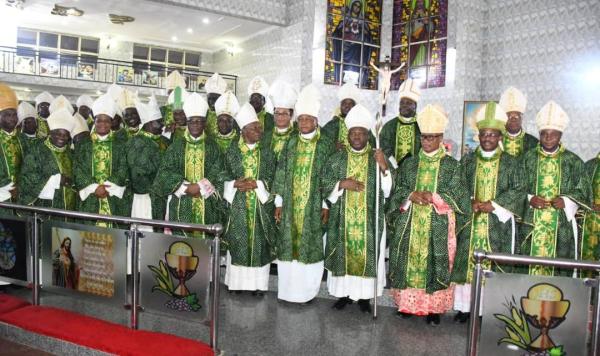
The Catholic Bishops Conference of Nigeria (CBCN) has issued a direct warning to the country's political elite against manipulating the upcoming 2027 General Elections through emerging technologies, weaponized poverty, and restrictive legislation. In a communiqué titled "Working Together for Upholding Human Dignity in Our Nation," released at the conclusion of their Second Plenary Assembly at the Our Lady and St. Kizito Pastoral Centre in Ede, Osogbo Diocese, the Catholic prelates raised serious alarms over deepening economic hardship, crumbling public infrastructure, persistent insecurity, and growing threats to civic space across the country.
- CBCN communiqué, signed by the President, Archbishop of Kaduna Matthew Man-Oso Ndagoso, and the Secretary, Bishop of Abeokuta Diocese Peter Odetoyinbo, laments that worsening killings and attacks continue to paralyze daily life and slow the nation’s economy. Widespread violence, kidnappings, and mass displacement continue to cripple agricultural productivity and commercial activities, leaving millions stranded in Internally Displaced Persons (IDP) camps and suffocating local financial ecosystems.
To ensure complete institutional fidelity to the primary text, the Bishops grounded their entire national address on the fundamental Catholic Social Teaching of human dignity, calling out rising sexual abuse, gender-based violence, and human rights violations.
Supporting the stance of Pope Leo XIV’s recent encyclical Magnifica Humanitas (On Safeguarding the Human Person) and the Vatican declaration Dignitas Infinita, the Conference asserted that human dignity is intrinsic, unconditional, and inviolable, rooted in creation and not subject to state whims or social utility. Addressing pastoral witness within the Church itself, the prelates acknowledged that religious credibility depends on firmly defending the weak, rejecting all forms of violence, and actively protecting victims of abuse.
A central focus of the assembly was the controversial Foreign Aids (Regulation, Transparency, and Disclosure) Bill 2026, currently advancing through the National Assembly. The Bishops firmly rejected the proposed law, warning that its broad discretionary provisions allow government authorities to deny registration or revoke operational licenses of civil society groups under the subjective guise of "national interest." They stressed that churches, mosques, and humanitarian organizations are already strictly regulated under the Corporate Affairs Commission (CAC) and existing laws, cautioning that the new bill risks stifling independent civic participation and obstructing critical aid to vulnerable citizens in conflict zones.
Looking ahead to the 2027 General Elections, the Conference cautioned political leaders against the unethical deployment of digital tools and Artificial Intelligence (AI) to subvert the democratic process or distort public perception. Citing Pope Leo XIV's recent encyclical Magnifica Humanitas, the hierarchy noted that while technology is a tool for human development, it is never neutral and must be governed by ethical boundaries. Underscoring the growing dangers within online spaces, the prelates warned that they are operating in an information environment that is increasingly complex, fast-moving, and at times volatile, where the proliferation of misinformation and disinformation poses a direct challenge to media credibility, national stability, public trust, and democratic legitimacy. Highlighting the deceptive power of modern technology, CBCN President Most Rev. Matthew Man-Oso Ndagoso noted that AI tools now allow false narratives to be produced at scale, at speed, and with a sophistication that makes detection exponentially harder. He further emphasized that disinformation in Nigeria is purposeful, exploiting ethno-religious fault lines, weaponizing identity, and targeting the populations least equipped to contest it, underscoring how calculated campaigns undermine social cohesion.
- also raised concerns over the growing reliance on automated political propaganda and unvetted algorithms designed to sway unsuspecting voters during election seasons. Furthermore, the prelates warned that the 2027 elections could witness the most technologically complex disinformation campaign in African history if urgent steps are not taken to strengthen verification systems and institutional response capacity. Specifically detailing these technological threats, the Bishops noted that AI-powered technologies could now generate highly realistic videos, images, and audio capable of misleading the public, stressing that synthetic deepfakes, hyper-realistic voice clones, and automated bot networks can easily synthesize non-existent political scandals or fake candidate statements to trigger instant civil unrest before truth can catch up.
Equally, the Conference sounded a clear pastoral warning against the resurgence of modern "neo-paganism" among Nigerian youths, a spiritual drift fueled by severe economic deprivation, unguided cultural revivalism, online idolatry, and shallow Christian formation. To counter this internet-driven phenomenon, the Bishops urged pastoral agents to aggressively deploy social media and digital catechism to teach Gospel truths, while advocating a balanced approach to cultural inculturation. Addressing the systemic collapse of public schooling, the CBCN demanded that federal and state governments fulfill their constitutional mandate to guarantee free, quality primary and secondary education for every Nigerian child, whether enrolled in public, private, or mission institutions. Reaffirming the Church's willingness to partner with the state as "Mother and Teacher," the Bishops insisted that human capital development must supersede political rhetoric.
Adding weight to these warnings from media monitoring bodies, Executive Director of the International Press Centre (IPC), Lanre Arogundade, said advancements in artificial intelligence had significantly complicated efforts to verify information, pointing out that deepfakes and AI-driven synthetic media are now capable of rewriting reality with alarming technical precision.
To build sustainable institutional defenses against this crisis, the CEMESO boss also announced plans to establish Campus Newsroom Labs in tertiary institutions to train young journalists in civic education and fact-checking practices, ensuring the next generation of reporters is equipped with technological tools to combat deepfakes and digital manipulation at the grassroots level.
Expanding on media integrity, the Bishops stressed that fact-checking must no longer be treated as an optional civic or journalistic responsibility, but as a core ethical obligation requiring proactive and technologically enabled verification systems to safeguard truth ahead of the polls. To meet this immense technical challenge, stakeholders are urging INEC to invest significantly in digital forensic capacity capable of detecting synthetic audio, manipulated videos, and AI-generated images before misleading content distorts democratic choices. In this regard, the CBCN announced plans for nationwide civic education, monthly Rosary processions, and declared December 8, 2026, as a national day of fasting and prayer for credible elections.
In an uncompromising critique of the country’s socio-economic conditions, the Bishops condemned the pervasive hardship across the nation, directly accusing political actors of using poverty as a "despicable instrument of control" to keep citizens in survival mode.
Reinforcing these concerns, the Northern States Christian Elders Forum (NOSCEF) urged President Bola Ahmed Tinubu to urgently look at what Nigerians are going through, step into the crisis, and reverse the latest increase in the pump price of Premium Motor Spirit (PMS). They warned that the government must not mistake the resilience and patience of suffering Nigerians for foolishness or acceptance.
In a statement signed by its Chairman, Elder Sunday Oibe, NOSCEF cautioned that rising fuel prices have further worsened economic hardship, pushing up food and transportation costs.
They noted that repeatedly hiking fuel prices directly drives up transportation costs, which has triggered a runaway inflation wave escalating the prices of basic foodstuff, medications, and everyday household commodities. The elders called on the Federal Government to explore sustainable revenue alternatives rather than routinely passing economic burdens onto impoverished citizens, urging President Tinubu to break through the veil of praise-singers and confront the harsh daily realities facing ordinary families.
- highlighted how severe infrastructure decay, characterized by bad roads, erratic power supply, and failing public utilities, paralyzes economic life, while unceasing violence, banditry, and community displacement continue to rob millions of their livelihoods. Going beyond standard road repairs, the Bishops specifically demanded nationwide railway network expansion to revive regional commerce, while charging citizens to actively protect public utilities against vandalism and expose corrupt infrastructure contractors. Analyzing the root causes of the crisis, the prelates noted that economic hardship is real and widespread, as unemployment, inequality, and rising living costs create extreme vulnerability and increase exposure to criminal recruitment, pressures that cannot be ignored in any serious analysis of insecurity.
nigeria catholic network
Speaking on the country’s security challenges, both the Bishops and Christian Elders stressed that national security matters most and called on political leaders to demonstrate greater sincerity and patriotism in addressing insecurity. The said that national interest should always come before personal or political interest, they urged the government to make community protection a priority. They reminded state authorities that citizens have every right to demand safety, and governments carry the paramount responsibility to provide it. The Bishops clarified that this is not an attempt to shift blame away from institutions or to diminish the responsibility of government, but a firm call for operational accountability. While acknowledging the government's move to decentralize the police system, the Conference explicitly warned against hijacking new police structures for personal, ethnic, political, or religious interests. They demanded state forces forcibly reclaim vast territories occupied by bandits, halt unceasing invasions of schools and places of worship, protect refugees, and immediately facilitate the safe return of millions of displaced citizens from IDP camps back to their ancestral homelands. The Conference urged the government to strengthen intelligence gathering and therefore called for a thorough review of the entire security voting process to ensure public resources are transparently aligned with protecting human lives.
Turning to ecclesiastical developments, the Bishops linked ecological protection directly to Catholic witness, using the Mass for the Care of Creation and the ongoing 8th Centenary of St. Francis of Assisi to urge national environmental safeguards.
The Conference celebrated Archbishop Alfred Adewale Martins’ appointment to the Vatican Dicastery for Evangelization, mourned the passing of Bishop Peter Nworie Chukwu (Abakaliki) and Archbishop Augustine Obiora Akubeze (Benin-City), and prayed for newly appointed Apostolic Administrators Most Rev. Ernest Obodo and Most Rev. Donatus Ogun.
- by Most Rev. Matthew Man-Oso Ndagoso (Archbishop of Kaduna and CBCN President) and Most Rev. Peter Olukayode Odetoyinbo (Bishop of Abeokuta and CBCN Secretary), the communiqué urged all levels of government to immediately fix critical utilities, dismantle oppressive economic policies, and commit to a moral politics centered on human dignity and the common good.
Addressing the core mechanisms of governance, the CBCN placed special emphasis on the upcoming political transition, warning that a transparent electoral system is the bedrock of national stability.
- Bishops also called on the electoral body to resist any external pressures that could compromise its independence, especially as preparations for the 2027 elections gather momentum. Emphasizing that the credibility of the Independent National Electoral Commission (INEC) hinges on its absolute impartiality, the Conference insisted that no political actor, state institution, or partisan interest group should be allowed to influence electoral operations, voter registration, or the collation of results.
nigeria catholic network
Expanding on this mandate, the hierarchy warned that institutional capture or political meddling in INEC's duties would severely erode public trust and trigger widespread voter apathy. They stressed that INEC leadership and field officers must act without fear, favor, or political bias, demonstrating uncompromising integrity in enforcing electoral guidelines.
Furthermore, the commission must immediately streamline voter registration, ensure the prompt, unhindered distribution of Permanent Voter Cards (PVCs) to all eligible citizens, and guarantee that electoral logistics, technology deployments, and results transmission channels are fully secured and publicly verifiable to eliminate suspicions of post-ballot tampering.
- prelates asserted that anything short of a transparent, free, fair, and credible election in 2027 would be a grave disservice to Nigeria, charging the commission to act as an unyielding custodian of the people's democratic mandate.
As Nigeria approaches a pivotal democratic crossroads in 2027, the warning from the Catholic Bishops and Christian Elders serves as a wake-up call to both the government and the electorate.
The leadership of the country must realize that no nation can thrive when its citizens are consumed by economic despair, crushed by inflation, and left at the mercy of insecurity. National security, food affordability, and human dignity are non-negotiable foundations of any functional democracy.
To the Nigerian electorate, the Church offers a firm charge to not surrender to despair or political apathy, rejecting the defeatist lie that votes do not count or that election outcomes are predetermined.
Voting remains the most powerful, peaceful weapon to reject bad governance, defeat vote-buying, and hold leaders accountable. The faith leaders strongly advise all eligible Nigerians to obtain their voter cards, turn out massively at the polls, and vote wisely for candidates of proven integrity, competence, and compassion.
By safeguarding the ballot box and actively participating in the democratic process, citizens can reclaim their nation's future and ensure that the true will of the people prevails.