



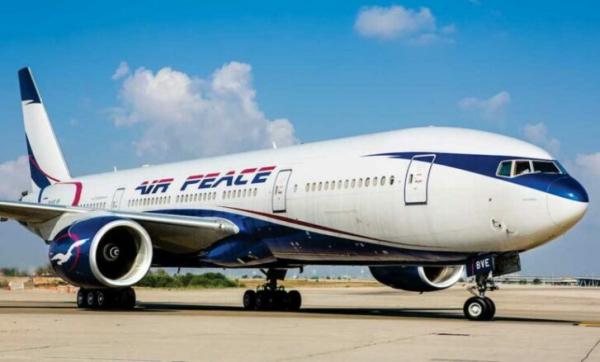
Nigeria’s largest carrier, Air Peace, lost more than N1 billion in a single day after aviation unions picketed its operations at the Murtala Muhammed International Airport (MMIA), Lagos, and the Nnamdi Azikiwe International Airport (NAIA), Abuja, grounding over 30 domestic flights and leaving hundreds of passengers stranded.
The picketing began in the early hours of Tuesday, with union members reportedly arriving at the airports about 3a.m — well before the airport’s usual 5a.m opening — to lock down access to Air Peace’s terminals ahead of its scheduled 6:30a.m departures.
Enugu airport was also barricaded, though operations there were said to have resumed after some disruptions.
The action was led by the National Union of Air Transport Employees (NUATE) and the Air Transport Services Senior Staff Association of Nigeria (ATSSSAN), together with the National Association of Aircraft Pilots and Engineers (NAAPE), and backed by the Nigeria Labour Congress (NLC) and the Trade Union Congress (TUC).
Speaking to Daily Independent, Air Peace spokesperson, Efe Osifo-Whiskey, described the scale of the disruption: “We had 30 flights that were cancelled and counting… so on a normal day we operate at the lowest, 70 flights per day.”
He said the airline typically earns “over 1 billion in revenue” a day from its operations, and confirmed by the end of the day that the losses had been “confirmed now” at “over a billion naira.”
Osifo-Whiskey said the airline would issue refunds and try to re-accommodate affected passengers on future flights, adding that some travellers had already sought alternative arrangements.
He also alleged that a female member of staff was assaulted during the picketing: “There was a lady that was beaten… I have a picture of the lady that was bleeding.”
He noted that international and regional Air Peace flights were unaffected, with the disruption confined to domestic operations out of MM1, MM2 in Lagos and NAIA in Abuja.
According to Osifo-Whiskey, other domestic carriers — including ValueJet, Ibom Air, Enugu Air and Aero — operated without interruption, while United Nigeria Airlines cancelled one of its own flights in a show of solidarity with Air Peace and apologised to its passengers.
The Unions’ Grievances And Demands
According to union statements, the picketing followed a notice issued on August 4, 2026, in which the unions warned they were prepared to strike “at any time without further notice.” They said the latest action represented restraint, having given the airline time to respond before escalating.
The dispute centres on two main allegations against Air Peace: Non-remittance of the 5% Ticket Sales Charge (TSC) — a statutory levy on ticket sales meant to fund the Nigerian Civil Aviation Authority (NCAA) and other aviation agencies.
Unions put the outstanding sum owed by the airline at around N15 billion, and say the shortfall has stalled implementation of collective bargaining agreements already negotiated for their members.
Alleged anti-union practices — the unions accused Air Peace of frustrating employees’ efforts to unionise freely, in what they characterised as a breach of workers’ rights to freedom of association. Notably, a group representing Air Peace’s own workforce, led by Comrade Aminu Suleiman, publicly distanced itself from the action, saying staff had “always had a voice in the running of the company” over its twelve years of operation and saw no need to join an external union.
The NCAA, which oversees remittance of the TSC, had reportedly said prior to the picketing that it had already reached a payment arrangement with airlines — including Air Peace — to offset TSC arrears that accumulated after jet fuel prices spiked sharply during US-Iran war.
That existing arrangement became a point of contention once the NCAA’s statement was seen by some as appearing to reference — and thereby lend legitimacy to — a proposed meeting convened by the Minister of Aviation, prompting criticism that the regulator’s messaging blurred the line between appealing for calm and appearing to justify the unions’ action.
The unions’ picketing took place even as Festus Keyamo, the Minister of Aviation and Aerospace Development, was said to be actively mediating the dispute. Industry voices criticised the unions for pressing ahead with the action while the minister’s intervention was ongoing, with the Aviation Safety Round Table Initiative (ASRTI) accusing the unions of acting “in utter disregard of the ongoing intervention of the Honourable Minister of Aviation and Aerospace Development.”
The ASRTI issued a strongly worded statement condemning the picketing as unlawful, arguing that it breached Section 29 of the Civil Aviation Act, which designates services supporting flight operations, passenger embarkation and cargo handling as essential services where strikes, lockouts, pickets and blockades are prohibited.
The group also cited Section 18 of the Trade Disputes Act, which it said bars strike action while a dispute is under official mediation. It further argued that singling out Air Peace for picketing, while other carriers operated freely, showed “clear bias from a group that claims to preach fairness,” and called on unions to pursue grievances over TSC remittance through legal and administrative channels rather than airport disruption.
Sindy Foster, Principal Managing Partner at Avaero Capital Partners, was similarly critical, questioning what the picketing achieved industrially.
“Passengers are not bargaining chips, and individual airlines should not be used as proxy targets in a wider industrial dispute of undetermined legitimacy,” she said, adding that reports of protesters encouraging Air Peace passengers to switch to rival airlines, and of a staff member left bleeding, suggested the action had “gone considerably beyond legitimate industrial action.” She described the disruption as “anti-passenger, anti-industry buffoonery” that “needs to stop.”
Both sides appear headed back toward negotiation, as the ASRTI called for an immediate halt to blockades and for all parties to return to the mediation framework set up by the Aviation Ministry, while insisting that TSC debt recovery should remain strictly a matter between the NCAA and the airlines concerned, without disrupting the wider travelling public.
On its part, Air Peace said it would focus on refunding and re-booking affected passengers: “So, of course, there will be refunds. That’s the best thing we can do, of course. The best thing we can do is appeal to the passengers and find a way to either re-accommodate them to future flights if possible. They can open their tickets and use them for future days because some of them have found alternative options.”
At the time of filing this report, the unions were reportedly called to order by concerned authorities. Although there is no official statement announcing the end of the strike.