


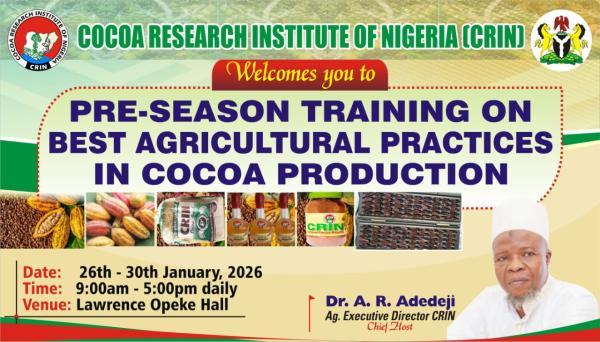
The Cocoa Research Institute of Nigeria (CRIN) has commenced its one-week pre-season training programme on Best Agricultural Practices (BAP) in cocoa production, as part of strategic efforts to enhance productivity, sustainability, and global competitiveness within Nigeria’s cocoa sector.
The five-day capacity-building programme, which began on Monday, January 26, 2026, is holding at the Lawrence Opeke Hall within the Institute’s premises. It brings together cocoa farmers, extension agents, farm managers, and supervisors from across cocoa-producing regions of the country.
The training is designed to equip participants with both theoretical and practical knowledge, as well as requisite skills, on best agricultural practices that will improve cocoa yield and quality, promote farm sustainability and traceability, reduce production losses, and ultimately increase income for farmers, government, and trading companies through environmentally sound and market-compliant cocoa production.
Declaring the programme open, the Acting Executive Director of CRIN, Dr. Abiodun Rasheed Adedeji, said the training was timely, given the increasing demands of the global cocoa market and the need for Nigeria to strengthen its production systems.
“This programme is essentially about why we are here as an institute and as stakeholders in the cocoa value chain,” Dr. Adedeji said. “CRIN was established to provide research-driven solutions that address the real challenges faced by farmers, and this training is one of the ways we translate research into impact.”
He provided participants with a brief historical overview of the Institute, highlighting CRIN’s mandate in research and development of cocoa and other mandate crops, while emphasizing the importance of adopting science-based practices to ensure sustainability.
“Our responsibility goes beyond research; it includes capacity building, extension support, and ensuring that Nigerian cocoa meets both local and international standards,” he noted. “When farmers adopt best agricultural practices, everyone benefits from increased yield and quality to better market access and improved livelihoods.”
Dr. Adedeji also encouraged participants to actively engage in the sessions, noting that the success of the programme would be measured by how well the knowledge gained is applied on farms after the training.
Following the opening ceremony, the programme progressed into a training overview session, during which CRIN researchers and resource persons shared insights on key technical areas critical to sustainable cocoa production.
The first training module focused on “Soil Management for Sustainable Cocoa Production,” addressing soil health, fertility management, and practices required to sustain long-term productivity. This was followed by Module Two, which examined “Cocoa Propagation Methods,” with practical discussions on budding, grafting, and pollination techniques.
Module Three, titled “Cocoa Best Agronomic Practices: Nursery to the Field,” provided participants with comprehensive guidance on good agronomic practices from seedling establishment through field management. The fourth module addressed “Agroforestry and the European Union Deforestation Regulation (EUDR),” highlighting the role of climate-smart practices and compliance with emerging global environmental standards.
Dignitaries present at the opening of the training included the Acting Executive Director, Dr. Abiodun Rasheed Adedeji, Dr. Samuel Orisajo, Director, Research Outreach, as well as other senior management staff and researchers of the Institute.
The pre-season training programme continues throughout the week, with additional practical sessions and interactive engagements expected to further strengthen participants’ capacity to implement best agricultural practices in cocoa production.
CRIN reaffirmed its commitment to supporting farmers and stakeholders with research-based knowledge and innovations aimed at repositioning Nigeria as a leading producer of sustainable, high-quality cocoa in the global market.