



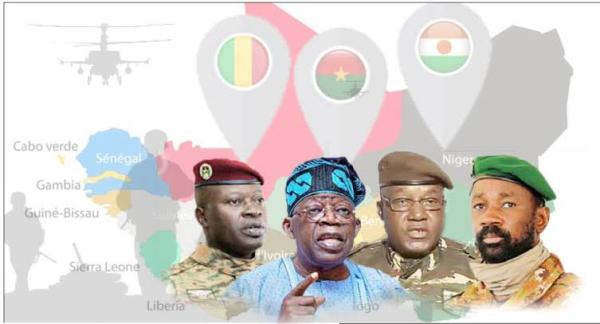
The withdrawal of Burkina Faso, Mali and Niger from the Economic Community of West African States (ECOWAS) has weakened key regional integration mechanisms and created significant challenges for cooperation across West Africa, the Presidency has said.
Special Adviser to President Bola Tinubu on Media and Public Communications, Sunday Dare, stated this on Thursday at a policy colloquium organised by the Ministry of Defence in Abuja.
The three Sahelian countries formally withdrew from ECOWAS in January 2025 after announcing their intention to leave the regional bloc in 2024. They have subsequently deepened cooperation under the Alliance of Sahel States (AES).
Dare said their departure had disrupted important regional mechanisms, particularly ECOWAS protocols designed to promote economic integration and facilitate the movement of goods and services across member states.
“The rupture that came in 2025, when the countries pulled out of ECOWAS, created a major regional crisis,” he said, noting that the development had also led to the emergence of the AES as an alternative regional framework.
He stressed the importance of effective border management to both economic integration and regional security, describing national borders as a critical frontline for maintaining stability.
According to him, properly managed borders can facilitate legitimate trade and movement while strengthening security, whereas weak border controls could provide opportunities for instability and other security threats.
Dare also dismissed claims that Nigeria's borders were closed, saying the country's borders remained open but were subject to necessary controls by relevant government agencies.
“Nigeria’s borders are open,” he said, cautioning politicians against turning border security into an electoral campaign issue or using it to score political points.
He explained that open borders should not be interpreted as unrestricted movement, stressing that immigration, customs and other security agencies remained responsible for regulating activities at Nigeria's entry and exit points.
“Our borders are critical. There are no open borders without controls. So, you must understand there is a distinction,” Dare said.