




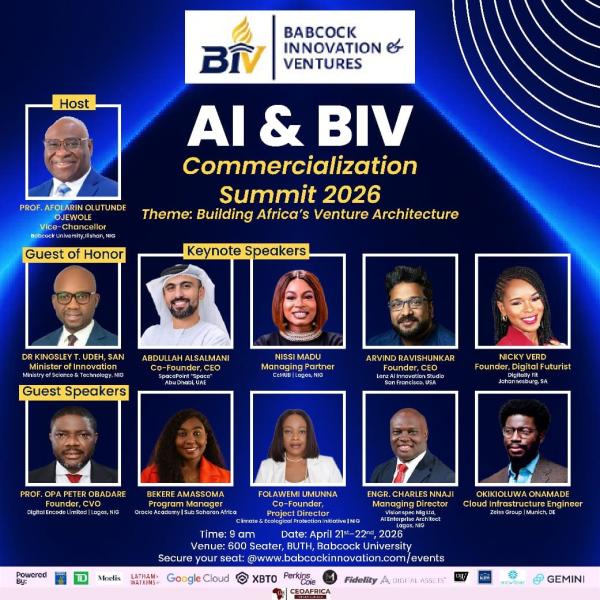
Babcock University has formally launched the Babcock Innovation and Ventures (BIV) architecture, marking a strategic transition into a venture-driven institution focused on transforming intellectual capital into scalable, market-ready solutions.
The announcement was made on Tuesday during the 2026 Artificial Intelligence, Babcock Innovation Ventures and Commercialisation Summit, held at the institution’s 600-capacity amphitheatre. Speaking at the event, the President and Vice-Chancellor, Professor Afolarin Olutunde Ojewole, declared that the traditional model of higher education is no longer sufficient in a rapidly evolving global economy.
“The question before every serious university today is not whether it has excellent faculty or rigorous curricula—those are necessary conditions, not sufficient ones,” he stated.
Professor Ojewole emphasized that modern universities must move beyond producing research confined to academic journals, prioritising instead the commercialisation of innovation to address real-world challenges. According to him, “producing graduates and publishing research papers constitutes an insufficient contribution to society,” noting that the global innovation ecosystem rewards institutions not for what they know, but for what they build, deploy, and bring to market.
Central to this transformation is the BIV framework—a university-wide system designed to integrate academic systems, research infrastructure, entrepreneurship development, and industry-capital engagement into a unified ecosystem. “It integrates four critical layers that, until now, have operated largely in isolation,” Ojewole explained.
The Co-Chair of the summit, Dr. Raymond Okoro, described BIV as a structured institutional platform that aligns governance, research, industry collaboration, and venture development, ensuring that innovation becomes deliberate, supported, and sustainable rather than incidental.
The BIV architecture operates through seven core service pillars, including idea incubation, startup acceleration, and a dedicated AI and Digital Innovation Lab. Highlighting Africa’s opportunity in the global innovation landscape, Ojewole stated, “The future of Africa will not be built by resources alone, but by ideas, technology, creativity, and courageous leadership.”
He noted that while artificial intelligence is reshaping industries, it also provides the foundational infrastructure for sectors such as healthcare and finance to scale through data-driven systems.
The BIV Centre is positioned as the engine room for translating research, innovation, and data into commercially viable products, enabling faculty and researchers to derive economic value from intellectual property. The initiative also aligns with ongoing efforts by the Federal Government of Nigeria to reposition universities as hubs for artificial intelligence and innovation.
Ojewole clarified that BIV is not a standalone programme but “the institutional architecture that transforms how Babcock University engages with the innovation economy,” supported by integrated legal and intellectual property frameworks.
As part of this shift, the university has restructured its curriculum to embed venture readiness across disciplines, with a strong emphasis on digital workforce enablement.
Delivering a keynote on the future of work, Nicky Verd of Digitally Fit, South Africa, stressed the importance of digital competence in an increasingly automated world. “People must move with the times; they must acquire relevant digital skills. You must be ready to evolve—to disrupt, not to be disrupted,” she said.
Also speaking, Okikioluwa Onamade of ZEISS Group, who facilitated a session on AI in digital health infrastructure, underscored the importance of data digitisation. He noted that while AI adoption is accessible, efficiency depends on structured, digitised data systems. “We cannot work with data that cannot be digitised,” he stated.
The summit featured a distinguished lineup of global experts and policymakers, including the Guest of Honour, Dr. Kingsley T. Udeh, whose participation underscored growing collaboration between academia and national policy.
Other speakers included Arvind Ravishunkar of Lenz AI Innovation Studio, Abdullah Alsalmani of SpacePoint, Nissi Madu of Co-creation Hub, Prof. Opa Peter Obadare of Digital Encode Limited, and Bekere Amassoma of Oracle Academy, alongside other industry contributors.
In his closing remarks, Professor Ojewole charged students to take ownership of the future, emphasizing that innovation must be guided by ethics and purpose. “The future is not something you wait for—it is something you build,” he said, adding that imagination, responsibility, and ethical leadership will define the next phase of global civilisation