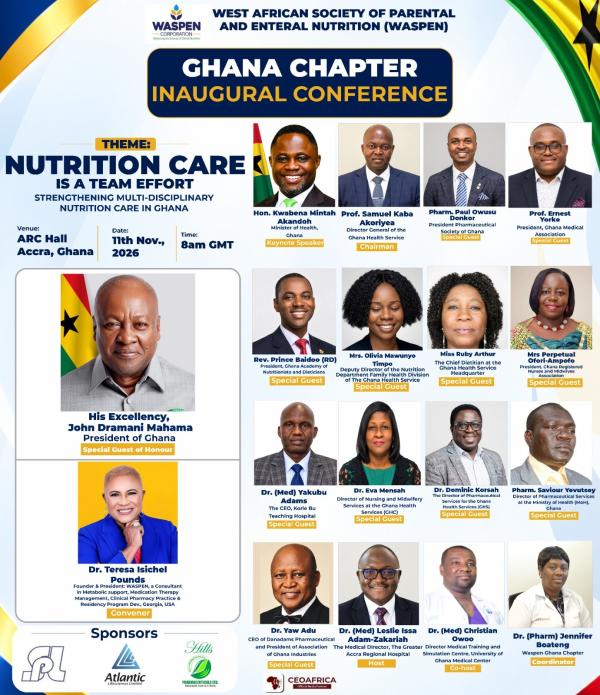





Dr. Teresa Pounds, President of WASPEN
The West African Society for Parenteral and Enteral Nutrition, in collaboration with the Indian Society for Parenteral and Enteral Nutrition, has called for an urgent overhaul of clinical nutrition protocols, urging hospitals to adopt a “golden hour” approach to nutritional screening as part of efforts to tackle rising cases of hospital malnutrition.
The call was made during a high-level global webinar themed “Strengthening Clinical Nutrition Care Through Effective Nutrition Assessment,” which brought together international experts to address what has been widely described as a silent but deadly global health crisis.
Delivering the keynote address, Dr. Daphnee Lovesley, Chief Clinical Dietitian at Apollo Hospitals, stressed the urgency of early nutritional intervention, noting that the crisis often begins at the point of admission. She revealed that every 60 seconds, at least 11 hospitalized patients go undiagnosed with malnutrition.
According to her, up to two-thirds of patients are already malnourished upon admission, with the figure rising to as high as 85 per cent in parts of Africa. She warned that delays in initiating nutritional care—particularly beyond the first 24 hours—significantly increase the risk of complications and mortality.
“If we delay our nutrition prescription for more than 24 hours, the patient is at extreme risk,” she cautioned.
Dr. Lovesley advocated a mandatory “golden hour” framework, recommending that all patients undergo nutritional screening within the first six hours of admission. She explained that early detection is essential in preventing complications such as sarcopenia—the accelerated loss of muscle mass and function—which contributes to frailty, increased fracture risk, and poor recovery outcomes.
She also highlighted the importance of adopting the Global Leadership Initiative on Malnutrition (GLIM) framework, which enables multidisciplinary teams to identify high-risk patients through indicators such as recent weight loss, reduced dietary intake, and disease severity.
Supporting the call for reform, Dr. Teresa Pounds, President of WASPEN, commended the insights shared and underscored the need for structured implementation of clinical nutrition systems across Nigeria.
She urged the Federal Government to adopt a coordinated, top-down approach to ensure the full operationalisation of the Nutritional Steering Committee (NSC) across healthcare facilities. According to her, effective implementation remains critical to reducing hospital-related malnutrition among in-patients nationwide.
Dr. Pounds further called on chief medical directors and hospital administrators across secondary and tertiary institutions, including private hospitals, to prioritise routine nutritional assessment for all admitted patients and to establish multidisciplinary nutrition steering committees to ensure screening within 24 hours of admission.
She emphasised that nutrition care must be recognised as a core component of successful treatment outcomes, noting that greater institutional commitment is required to address the challenge effectively.
“When we work together, we achieve more,” she said. “Nigeria is making meaningful progress toward establishing a Nutritional Steering Committee, but it is imperative that global best practices are domesticated. Accreditation bodies must integrate these standards into the healthcare system.”
Experts at the webinar also stressed the importance of a multidisciplinary approach involving physicians, nurses, and dietitians. Key recommendations included the adoption of protected mealtimes—where clinical interruptions are minimised to allow patients adequate time to eat—and a “food-first” protocol that prioritises natural dietary intake before supplementation.
Dr. Lovesley noted that untreated malnutrition can extend hospital stays by two to three days, while increasing vulnerability to infections, delayed wound healing, and premature death—further compounding the burden on already strained healthcare systems.
In her closing remarks, Dr. Pounds described clinical nutrition as a critical pillar of public health and patient care, calling for sustained commitment from all stakeholders. She also invited healthcare professionals to participate in the upcoming WASPEN conference scheduled for June 22-25, 2026 describing it as a key platform for advancing clinical nutrition practice across the region.
“Nutritional assessment remains the most effective tool for preventing morbidity and early mortality among patients,” she added, reaffirming WASPEN’s commitment to embedding nutrition at the centre of healthcare delivery in Nigeria and across West Africa.