




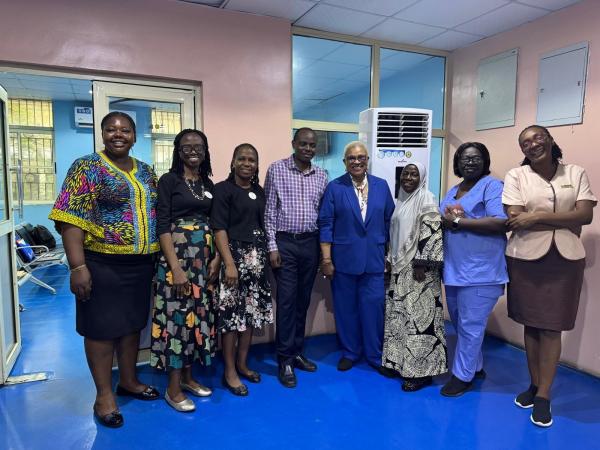
Group picture of WASPEN President, Dr. Teresa Isichei Pounds with LUTH’s Multidisciplinary Nutrition Support Steering Committee,
The West African Society of Parenteral and Enteral Nutrition (WASPEN) has intensified its efforts to institutionalize clinical nutrition across healthcare systems, with the Lagos University Teaching Hospital (LUTH) emerging as a leading model for multidisciplinary adoption.
During a high-level courtesy visit, WASPEN President, Dr. Teresa Isichei Pounds, engaged with LUTH’s Multidisciplinary Nutrition Support Steering Committee, designed to standardize patient nutritional screening and treatment protocols in line with global best practices. Leadership at LUTH was represented by Dr. Ayodeji Oluwole, Chairman of the Medical Advisory Committee, on behalf of the Chief Medical Director, Prof. Wasiu Adeyemo, with Dr. Felix Alakaloku, Chair of the Nutrition Steering Committee, also in attendance.
Dr. Pounds expressed strong satisfaction with LUTH’s implementation of WASPEN’s strategic framework, describing it as a milestone in the fight against hospital-based malnutrition. The team now ensures that all patients undergo mandatory nutritional assessment upon admission, delivering structured Medical Nutrition Therapy (MNT).
“Nutrition is a human right, not a privilege for the few. Together, let us unite against malnutrition—both in our communities and within hospital settings,” Dr. Pounds stated, emphasizing that undetected malnutrition continues to drive complications, prolonged hospital stays, and preventable mortality.
WASPEN commended LUTH for its clear institutional commitment, practical follow-through, and leadership support in embedding clinical nutrition into routine patient care. The hospital has established a functional multidisciplinary team and integrated nutrition screening and therapy into everyday workflows, demonstrating a sustainable model that can serve as a reference for other institutions. Leadership’s proactive resource allocation and support for professional collaboration have transformed clinical nutrition from a supportive service into a core, patient-centered component of modern medical care.
The multidisciplinary structure strengthens collaboration among healthcare professionals while defining complementary roles. Physicians oversee clinical integration, dietitians lead nutritional assessment and therapy design, pharmacists ensure safe formulation and monitoring of specialized nutrition therapies, and nurses manage day-to-day implementation and patient education. This coordinated approach not only improves outcomes but also reinforces the professional relevance of each discipline in advancing quality care.
WASPEN highlighted that LUTH’s leadership and commitment position the hospital as a benchmark for other tertiary institutions in Nigeria. Discussions during the visit explored ongoing technical collaboration, including capacity strengthening for team members, knowledge exchange initiatives, and documenting LUTH’s experience as a model for replication. These outcomes reflect WASPEN’s broader strategy to institutionalize safe, multidisciplinary, and equitable nutrition care nationwide.
Dr. Pounds praised LUTH’s leadership for translating vision into practice through resource allocation, committee strengthening, and institutional support. She noted that such commitment is essential for integrating nutrition into broader health system quality improvement and advancing national conversations around patient-centered care.