


The University of Ibadan came alive on Friday, November 26, 2025, as the Zoological Society of Nigeria (ZSN) formally opened its 18th Annual Conference, bringing together leading scholars, policymakers, researchers, industry stakeholders and students under the theme “Healthy Ecosystems: Path to Productivity and Sustainability.”
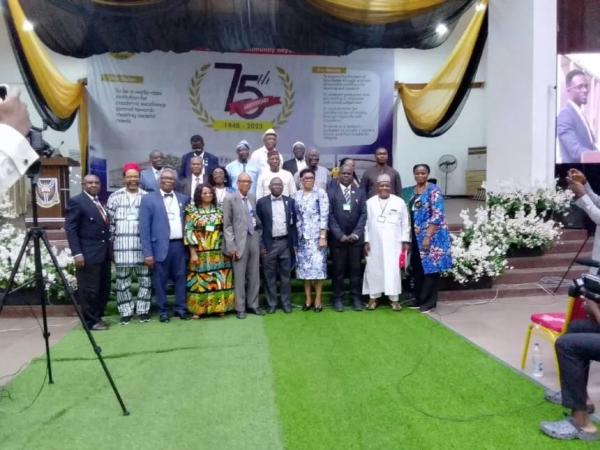
Held at the historic Trenchard Hall, the opening ceremony—attended both onsite and virtually—also featured the investiture of 14 distinguished scholars as Fellows of the Zoological Society of Nigeria, the highest professional honour of the body.
Delivering the Vice Chancellor’s message, the Deputy Vice Chancellor (Academics), Prof. Juwon Tunde Arotiba, warmly welcomed the array of dignitaries and delegates.
“A healthy ecosystem is not merely an academic concern; it is the foundation for economic resilience, public health, food security and long-term sustainability,” the Vice Chancellor stated through Prof. Arotiba.
He emphasized the central role of universities in driving research that shapes national environmental policy, stressing that multidisciplinary collaboration is essential to solving Nigeria’s complex ecological challenges.
“A productive nation must be driven by a productive knowledge system. No single discipline can address today’s environmental uncertainties,” he added, commending ZSN and the Department of Zoology for their innovation in hosting a hybrid, inclusive scientific conference.
Earlier in his welcome address, ZSN National President, Prof. Alexander B. Odaibo, highlighted the historical significance of hosting the Society’s 18th conference at the premier university where ZSN held its inaugural meeting in 2003.
He praised the Local Organizing Committee for “re-inventing what a scientific conference should be,” especially by incorporating a pre-conference workshop aimed at supporting early-career zoologists.
“The theme of this conference has significant relevance to our current economic realities and the global climate crisis,” Prof. Odaibo said.
He congratulated the 14 new Fellows, describing their recognition as a testament to their distinguished contributions to zoology, science, and society.
In her remarks, Head of the Department of Zoology and LOC Chairperson, Prof. Aina O. Adeogun, expressed delight over the impressive number of abstracts submitted from across Nigeria and beyond.
“The multidisciplinary contexts of the abstracts show how modern science now thrives on the infusion of diverse disciplines,” she noted.
Prof. Adeogun appreciated dignitaries such as former President Dr. Goodluck Jonathan, Her Excellency Mrs. Bamidele Abiodun, and several distinguished alumni for supporting the conference’s plenary sessions. She also acknowledged retired professors described as “living legends” for their continuous mentorship.
Delivering the first keynote address virtually, Prof. Babatunde Bolaji Bernard, Senior Special Adviser to the SGF, spoke on “Sustainable Ecosystem Resource Use: A Panacea to Ecosystem Health.”
He explained the interdependence of ecological systems, emphasizing the critical role of biogeochemical cycles, biodiversity, and environmental carrying capacity in sustaining life.
“Human populations are increasing at rates that make resource removal far outweigh natural recovery. Sustainable development is now a necessity, not a slogan,” he warned.
Prof. Bernard urged stronger adoption of Environmental Management Systems (EMS) and Environmental Impact Assessments (EIA) as tools for protecting biodiversity and promoting long-term ecosystem stability.
The second keynote speaker, Prof. Christian Happi, Director of ACEGID, Redeemer’s University, delivered a high-impact presentation titled “Genomic Surveillance and Characterization of Microbial Threats Facilitate Early Detection and Containment of Disease Outbreaks in West Africa.”
He traced ACEGID’s pioneering contributions to epidemic response—including breakthroughs in Ebola, Lassa fever, yellow fever, COVID-19, Marburg virus, and Mpox. “We are transforming outbreak response in the pathogen-genomic era,” he said.
Prof. Happi highlighted the Centre’s landmark achievements such as: developing the first Ebola Rapid Diagnostic Test, sequencing the first whole genomes of Lassa virus, enabling genomic tracking that helped contain Rwanda’s 2024 Marburg outbreak in 66 days, identifying a fast-spreading new Mpox variant in Sierra Leone, and deploying genomic surveillance tools across West and Central Africa.
He cautioned that microbial threats are evolving faster than traditional surveillance systems, reinforcing the need for sustained investment in genomic infrastructure across the continent.
The conference drew several high-profile personalities and distinguished scholars, including the Vice-Chancellor of the University of Ibadan, Prof. Kayode Oyebode Adebowale, represented by the Deputy Vice-Chancellor (Academics), Prof. Juwon Arotiba; the University Librarian, Dr. Mercy Iroaganachi; and the University Bursar, Mr. Adewuyi Popoola, represented by Prof. I. O. Popoola.
Also present were the President of the Zoological Society of Nigeria (ZSN), Prof. Alexander B. Odaibo; ACEGID Director, Prof. Christian Happi; departmental “Living Legends” such as Prof. Solomon Fagade, HRH Alaiyeluwa Oba Prof. Titilayo Hassan, and Prof. A. I. Oladosu, Dean of the Faculty of Science. The event further hosted the Head of the Department of Zoology and Chairperson of the LOC, Prof. Aina O. Adeogun, alongside other deans, and stakeholders.
Speaking to CEOAFRICA in an exclusive interview on the sidelines of the event, Prof. Odaibo emphasized that zoologists contribute significantly to national development beyond the public’s narrow perception of “animals and zoos.”
“Zoology is deeply multidisciplinary. From food production to climate change adaptation, zoologists are working in different spaces to provide knowledge that helps society develop, he said.
He added that the theme of the conference reinforces the reality that a productive nation must first maintain a healthy ecosystem, as every organism contributes to the stability of the environment.
The opening ceremony of ZSN 18 showcased Nigeria’s finest minds in zoological and environmental sciences, blending academic insight, policy direction, and recognition of scientific excellence.
With its hybrid format, diverse abstracts, high-level keynotes, and strong institutional support from the University of Ibadan, the conference set a dynamic tone for days of stimulating discussions and impactful collaborations.
The event closed with a charge to participants to engage deeply, collaborate widely, and advance research that strengthens ecosystems, institutions, and national development.