



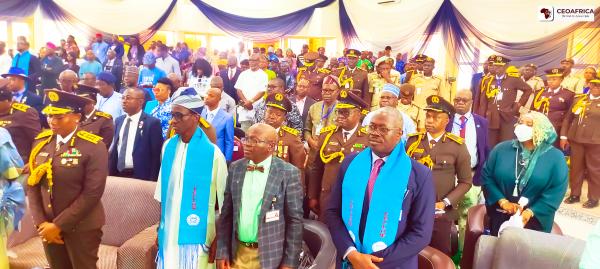
The Society for Peace Studies and Practice (SPSP), in collaboration with the Institute for Peace and Strategic Studies (IPSS), University of Ibadan, on Tuesday, November 25, 2025 held the opening ceremony and awards presentation of its 19th International Annual Conference, General Assembly, and Investiture of Fellows.
The colourful event, hosted at the Abiola Ajimobi Resource Centre, Parry Road, University of Ibadan, drew participants from around the world—including diplomats, academics, researchers, military officers, policymakers, humanitarian workers, students, and peacebuilding practitioners.
This year’s four-day conference is themed “Economic Challenges and the Tasks of Building Sustainable Peace in a Globalised World.”
A major highlight of the opening session was the induction of 40 distinguished members as Fellows of SPSP in recognition of their outstanding contributions to peacebuilding and national development. The ceremony also featured a moment of prestige as the Chairman, Board of Trustees, Prof. Sulaiman Elias Bogoro, was admitted into the SPSP Hall of Fame.
Welcoming delegates, the Vice Chancellor of the University of Ibadan, Prof. Kayode Oyebode Adebowale, said the conference theme speaks directly to the realities shaping global stability.
He noted that the world’s deepening inequalities, volatile markets, climate-driven resource scarcity, and rising unemployment feed insecurity across continents. “These economic pressures,” he said, “translate into daily struggles for survival, dashed hopes and a pervasive sense of injustice.”
He stressed that the absence of economic stability often fuels violent conflict, criminality, and social disintegration. Speaking on the role of academia, the VC emphasized that UI remains committed to interdisciplinary research, community engagement, and training leaders who understand the complex links between economics and peace.
In a stirring call to action, he urged participants to embrace innovation, justice and inclusion: “Let us forge stronger dialogue between economists, peacebuilders, policymakers, business leaders and community actors. The task before us is immense, yet fully achievable. We must respond with courage, urgency and empathy.”
Serving as the Father of the Day, former Osun State Governor and UI Governing Council Chairman, Chief Adebisi Bamidele Akande, commended the Society, noting that SPSP’s origins in the University of Ibadan remain a point of pride.
He described the conference as timely, citing global tensions—from Gaza to Ukraine, and from the Democratic Republic of Congo to the intensifying rivalry between China and the United States. “We are witnessing an era,” he said, “where principles of justice and human dignity are being replaced with transactional policies and opportunism.”
Akande emphasized that peace is more than the absence of war; for Africa, peace embodies justice, social integration, and collective human progress. “Until our young population is adequately trained in science and technology to unlock the wealth of our nation, the war against ignorance and poverty will continue to hold us down,” he added.
Chairman of the SPSP Board of Trustees, Prof. Elias Bogoro, expressed delight at the growing international footprint of the Society. He praised UI’s hospitality and noted that more institutions have begun sponsoring SPSP programs. “We are proud to recognize individuals through Fellowship because SPSP has demonstrated its relevance to Nigeria’s peace landscape,” he said.
President of SPSP, Mr. Nathaniel Msen Awuapila, reaffirmed the Society’s commitment to expanding local and international partnerships. He highlighted the establishment of SPSP branches in Sierra Leone (2023) and Cameroon (2024), as well as ongoing collaborations with sub-national governments in Nigeria.
Awuapila expressed concern that Nigeria, at 65 years of nationhood, still operates without a national peace policy. He recalled his recent engagement with the Speaker of the Oyo State House of Assembly, Rt. Hon. Adebo Ogundoyin, saying:
“He urged us to develop a structured peace policy for Oyo State, which can later serve as a model for national adoption. This shows the growing trust in SPSP as a partner in governance.”
In his keynote address, former Chief of Defence Staff, Gen. Christopher Gwabin Musa (rtd.), delivered a blunt assessment of Nigeria’s security landscape. “Without peace there can be no development,” he stated. “We study peace, but we don’t practice it.”
He argued that the modern world requires integrated approaches where peace, security, and economic well-being are treated as interconnected goals rather than isolated tasks. “The absence of war does not mean peace,” he said. “Peace is the presence of justice, opportunity, and hope for a better tomorrow.”
Gen. Musa emphasized youth employment as a strategic national security priority: “An idle generation is a ticking bomb. Investing in skills and the digital economy is not just development—it is peacekeeping.”
He concluded with a challenge to Nigerians to rebuild values, productivity, and unity so that the country can achieve the progress it deserves.
Joining virtually from Rwanda, Dr. Ozonnia Ojielo, United Nations Resident Coordinator, highlighted global UN interventions in building sustainable peace, particularly in post-conflict societies.
He emphasized the need for inclusive governance, gender equality, and community-driven solutions. “Sustainable peace requires societies to address structural violence, economic exclusion, and the governance deficits that fuel insecurity,” he said.
He encouraged African states to strengthen early-warning systems and invest in local peace infrastructures that prevent conflict before it escalates.
Representing the Governor of Benue State, Hon. Ephraim Aondowase Kunde, the Commissioner for Humanitarian Affairs and Disaster Management, expressed appreciation for the recognition bestowed on the Governor.
He said the state has adopted data-driven and community-rooted frameworks to address displacement, revamp security architecture, and foster dialogue. “Our approach reflects what scholars call a human-centred security model—one that protects lives, livelihoods and fundamental rights,” he said.
Kunde invited SPSP to Benue State to observe ongoing peacebuilding initiatives and strengthen collaboration.
The Speaker of the Oyo State House of Assembly and Chairman, Conference of Speakers of State Legislatures of Nigeria, Rt. Hon. Adebo Edward Ogundoyin, stressed the need for a national peace framework.
He said: “At a time when our nation faces deepening challenges, this gathering is essential. The Legislature remains open to partnerships that will strengthen our laws, deepen cohesion and promote lasting peace.”
Representing the President, the Senior Special Assistant on Community Engagement (North Central), Dr. (Mrs.) Abiodun Essiet, reaffirmed the government’s peace and security agenda.
She disclosed ongoing deployments of advanced technology—including drones and naval digital systems—to combat terrorism and organized crime. “Mr. President is committed to sustaining peace across Nigeria,” she said.
She added that the Community Engagement Office was created to strengthen inclusion, amplify grassroots voices and reinforce social cohesion. “Community engagement is key to building sustainable peace. We must remain united across ethnicity and religion to defeat the enemies of our nation,” she concluded, invoking the African philosophy of Obuntu: “I am because you are.”
The event was graced by a distinguished lineup including former Chief of Defence Staff, Gen. Christopher Musa; former Governor Chief Adebisi Bamidele Akande; UI Vice Chancellor, Prof. Kayode Adebowale; SPSP President, Mr. Nathaniel Awuapila; Prof. Sulaiman Bogoro; Comptroller General of Immigration, Kemi Nanna Nandap; Hon. Ephraim Kunde representing the Benue State Governor; Dr. Abiodun Essiet representing the President; Sierra Leone’s SPSP Coordinator Mr. Teddy Foday-Musa; Emeritus Prof. Olufemi Bamiro; and the Founder of SPSP, Prof. Isaac Olawale Albert.
Top government officials, security experts, media executives, academics, and international delegates have reiterated their commitment to strengthening Nigeria’s peace architecture, during exclusive interviews with CEOAFRICA on the sidelines of the Conference.
Representing the Presidency, Dr. Abiodun Essiet, Senior Special Assistant to President Bola Ahmed Tinubu on Community Engagement (North Central), emphasized the administration’s determination to restore nationwide peace and security.
She said: “We have academia, technocrats, security agencies from both the public and private sectors here, all discussing peace architecture in Nigeria and how we can strengthen peace. I am here to reassure them of the President’s commitment and to learn from the outcomes of this gathering.”
Reacting to the recent kidnapping incident in Kwara State, she added: “The President is working round the clock with security agencies to ensure lasting peace. We have deployed sophisticated drones, digital systems, and other innovative technologies across the military, navy, and other security formations to tackle criminal activities.”
Essiet explained that the Community Engagement Office was created to bridge the gap between government and grassroots communities, driven by principles of inclusion and social cohesion.
Also speaking, the Speaker, Oyo State House of Assembly, Rt. Hon. Adebo Edward Ogundoyin, highlighted the crucial role of lawmakers in strengthening internal security mechanisms.
He told CEOAFRICA: “The legislature has done a lot, but we need to do more. We sponsored the bill establishing Amotekun and we constantly review our laws to ensure peace exists at both state and national levels.”
He stressed collaboration with the federal government, noting: “With the leadership of the President and state governments working together, we should attain a minimum level of peace across all 36 states. We are fully committed.”
Former Chief of Defence Staff, Gen. Christopher Gwabin Musa (rtd.), called for unity among all citizens as the foundation for national stability.
Though brief in his remarks, he offered a strong message: “Everybody in Nigeria must work together as one family, one team, for us to attain peace.” He further noted that sustainable peace requires public cooperation alongside military effort.
The Executive Director of Agidigbo FM, Mr. Oriyomi Abdul-Rahman Hamzat, challenged media practitioners to uphold their nation-building responsibilities. “The media is the opinion moulder of society. We have an important role to play and we have neglected it. If we pick it up intentionally and do it well, society will change,” he said.
International delegates from Sierra Leone expressed admiration for Nigeria’s peacebuilding strides and for the University of Ibadan’s foundational role in the establishment of SPSP.
Aminah Afofana, Assistant Coordinator (SPSP Sierra Leone), said: “My presence here speaks volumes. The SPSP fellows in Nigeria clearly prioritize peace. The conference experience is rich and worth taking home.”
Mr. Teddy Foday-Musa, Coordinator (SPSP Sierra Leone), added: “I now understand why SPSP could survive starting from UI. Meeting Prof. Isaac Olawale Albert, the founder, was inspiring. We are returning home with renewed motivation to move SPSP Sierra Leone forward.”
He also praised UI’s entrepreneurship program, noting it as a model Sierra Leonean universities should emulate.
Another Sierra Leonean fellow said he felt “humbled and delighted” to receive his fellowship recognition, calling it a major boost to his peacebuilding work in Sierra Leone.
Outgoing SPSP President, Mr. Nathaniel Msen Awuapila, reflected on the Society’s growth under his leadership since 2020. “I am the fourth president since SPSP was established. It is an honour. Bringing together worthy experts and stakeholders at international and national levels in one gathering is remarkable,” he said.
He noted that the 19th International Conference addressed a critical theme, adding: “The papers presented so far show that the conversations must be sustained.”
Awuapila praised SPSP’s expansion, achievements, and new status: “We now have international branches in Sierra Leone and Cameroon, with plans to expand into other African regions within two years. We also secured ECOSOC recognition and strengthened partnerships with government institutions and military agencies.”
He emphasized that peacebuilding must not be treated as a one-off project: “It involves social and behavioural change. SPSP must keep engaging government, plan with them, and support them to succeed.”
With powerful reflections, renewed commitments, and the investiture of new Fellows, the opening ceremony set a strong tone for the days ahead. As scholars, practitioners, government officials, and international partners shared their thoughts, the 19th SPSP International Conference stands as a reminder that building sustainable peace in a turbulent world requires collective wisdom, courageous leadership, and an unwavering dedication to justice, inclusion, and human dignity.